
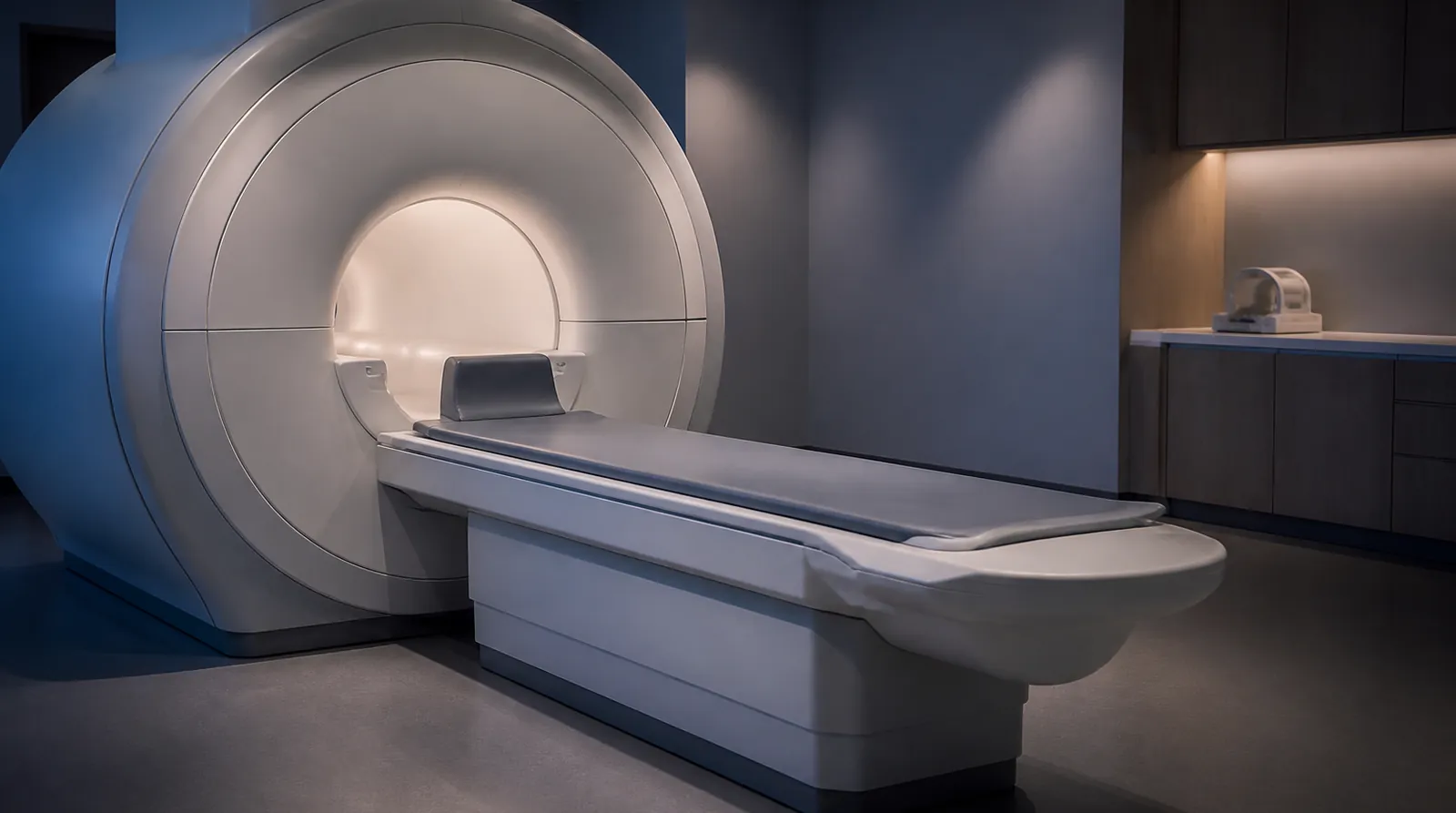

Yes, you can have an MRI with braces. They do not usually stop a scan from happening, but the metal can distort the picture, and for some scans the radiologist will want the wire or brackets removed first. Which scans are affected depends on where the scanner is pointed.
This article explains what research on braces and MRI found, which scans are affected, and what to tell the imaging team before you book. It is not a reason to delay a scan your doctor wants done. Imaging comes first, and we can help with the metal.
What braces do to an MRI picture
An MRI measures signals from your tissue inside a strong magnetic field. Metal disturbs that field nearby, and the result is an artefact: a dark patch or warped area where the image cannot be read. Stainless steel brackets and wires cause more of it than other materials.
In a 2017 study in Dentomaxillofacial Radiology, Italian researchers scanned 80 adults at 3 tesla. Twenty wore clear aligners and served as the comparison group. The rest had stainless steel brackets with no wire, with a nickel-titanium wire, or with a stainless steel wire. Two neuroradiologists scored the images. Scans of the neck, the sinuses, the head and neck region and the cervical spine were often not diagnostic in the bracket groups. Scans of the temporomandibular joint, the jaw joint, were readable in every group.
The brain was less clear cut. The authors concluded that brain scans should not need removal, but their own results describe some artefact in the frontal lobe, so the final call belongs to the radiologist who knows what they are looking for.
Which scans matter
The pattern follows distance. The closer the area being scanned is to the mouth, the more likely the braces are to get in the way. Sinus, neck and upper spine imaging sit closest, and those were the scans the study found hard to read. The study did not look at other parts of the body, but a knee, a shoulder or a lower back scan is a long way from the mouth.
| Scan area | Stainless steel brackets, 2017 study |
|---|---|
| Neck (cervical region) | Often not diagnostic |
| Sinuses | Often not diagnostic |
| Head and neck region | Often not diagnostic |
| Cervical spine | Often not diagnostic |
| Jaw joint (temporomandibular joint) | Readable in every group |
| Brain | Authors say removal should not be needed, though some frontal-lobe artefact was described |
Keep the limits of one study in mind. The patients were adults between 20 and 29, the scanner was 3 tesla, and the hospital or clinic that images you may use a different machine and different settings. That is one more reason to let the imaging team decide.
Is it safe?
Safety and image quality are separate questions. The Italian authors did not measure heating themselves, but they cite laboratory studies where fixed braces warmed by less than about 3 degrees Celsius at 3 tesla, which they considered acceptable. Imaging departments screen everyone for metal, so mention your braces on the form.
Tell them about a bonded retainer too. That is the thin wire fixed behind the front teeth, and it is metal. The team will want it on the record even when it is not in the way of the scan.
What removal involves
If the radiologist asks for the metal to come out, there are two possible steps. Taking out the archwire is the smaller one. The wire is released from the brackets and slipped out, and the study authors recommended removing it before MRI even when the brackets stay, because the wire also reduced image clarity. It is usually a short visit, and a wire goes back in afterward.
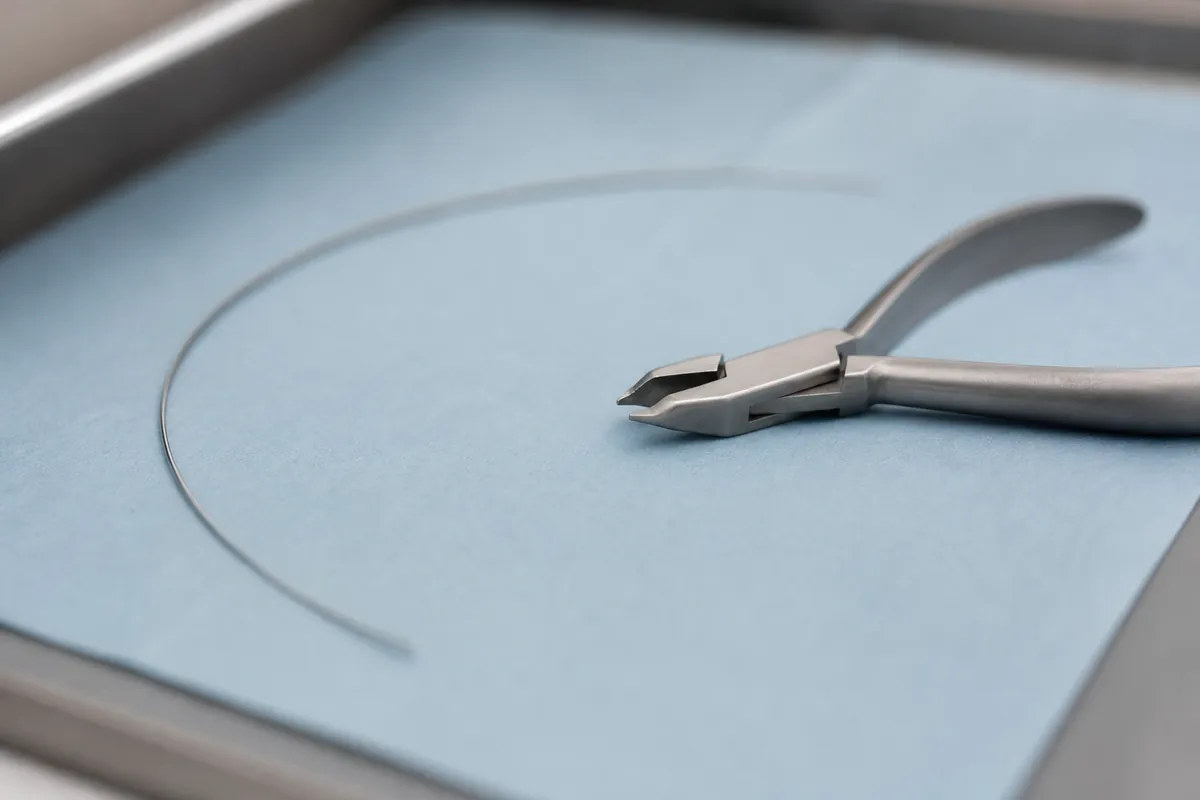
Removing the brackets is a bigger decision, because it means taking the braces off and putting new ones on later, with extra visits and cost. The brackets are bonded to the teeth, so this is not a quick step. That is why the question to settle is whether the scan really needs it. For a sinus or neck scan the answer may be yes. For a brain or jaw-joint scan it may be no.
If the scan is urgent, tell your doctor that you wear braces and call us the same day so we can talk through the options. Never cut or pull a wire out yourself to get ready.
Ceramic brackets and aligners
Materials change the picture. The Italian authors point to earlier laboratory work showing smaller artefacts with plastic, ceramic and titanium brackets, and suggest those may suit patients who expect to need MRI scans. Clear aligners come out of the mouth, so there is nothing in place to cause an artefact once they are removed.
If someone in your family has a condition that needs repeated head or neck imaging, mention it when you plan treatment. It can affect the choice of brackets. Ask your orthodontist what your brackets are made of, and see our pages on clear braces and clear aligners for the options we offer.
Who to tell and when
Tell three people: the doctor who orders the scan, the imaging booking line, and your orthodontist. Edmonton hospitals and community imaging clinics each run their own screening, so ask what they want to know about metal and whether they have a preference about wire removal for your type of scan. Give them the type of brackets, the wire material if you know it, and whether you have a bonded retainer.
If the imaging team needs details from us, call the office and we will help. Do it a few days ahead if the scan is booked, since a wire removal visit needs to be scheduled around it.
The short answer
Braces do not usually block an MRI, but the metal can blur scans of the neck, the sinuses and the areas near them, while brain and jaw-joint scans are less affected. Tell the imaging team about your braces and any bonded retainer, let the radiologist decide what comes out, and call us if the wire needs to be removed. If you are thinking about treatment and expect regular scans, raise it at a complimentary consult.