

White spots after braces are chalky patches on the tooth surface, usually in a frame around where a bracket sat. They form when plaque stays against the enamel and the acid it produces dissolves minerals just under the surface. A 2025 review that pooled 57 studies and more than 9,000 patients found at least one white spot in about 55 per cent of people who had braces, and the odds rose the longer treatment ran.
Careful cleaning and the right fluoride lower the risk, and spots that do form usually soften a little after the braces come off. Edmonton adds fluoride to its tap water, which helps the enamel, but a glass of water does not clean around a bracket.
What a white spot is
Enamel is mostly mineral. Each time you eat or drink something sugary, bacteria in plaque make acid, and for a while afterward the minerals at the surface of the tooth dissolve. Saliva and fluoride put them back. Around a bracket, plaque is hard to brush away and can sit for hours, so the balance tips toward loss. When enough mineral leaves from just under the surface, the enamel scatters light differently and the spot looks chalky white.
This is the earliest stage of tooth decay. While the outer layer is intact, the area can often harden again. If the surface collapses, it becomes a cavity and needs a filling.
How a white spot forms
Step 1
Plaque settles
Soft plaque collects at the edge of a bracket, where a toothbrush reaches poorly.
Step 2
Acid does its work
Bacteria turn sugar into acid. Minerals leave the enamel just under the surface.
Step 3
Braces come off
The weakened patch scatters light differently, so it looks chalky next to healthy enamel.
A simplified side view of one tooth, not to scale. The same process can start in people without braces, but a bracket makes plaque much harder to remove.
People who have never worn braces get white spots too. The 2025 review found them in about 29 per cent of untreated participants, so braces raise the odds rather than create the problem.
Share of people with white spots
No braces
29.1%, pooled from 21 studies
New spots during braces
34.2%, incidence, 44 studies
Any white spot with braces
55.1%, prevalence, 42 studies
Pooled estimates from Hussain and colleagues, Orthodontics and Craniofacial Research, 2025 (57 studies, 9,101 patients, mean age 16.4). Individual studies range widely, from 27 to 97 per cent in one 2024 review, depending on how and when spots were counted.
The 55 per cent is a middle estimate across many studies and says little about any one person's mouth. The average age in those studies was 16, which makes this a particular concern for parents of a teen starting braces.
What Edmonton's water does and does not do
EPCOR has fluoridated Edmonton's water since 1966. The North Saskatchewan River carries about 0.1 parts per million of fluoride on its own, and EPCOR tops that up to 0.7, the level Health Canada recommends. Whether to fluoridate is a municipal decision, so if you live outside the city, ask your own town's water utility what it does.
Alberta has also run an unplanned experiment. Calgary stopped fluoridating in 2011 and Edmonton did not. University of Calgary researchers examined Grade 2 students in both cities in 2018 and 2019 and found cavities in the baby teeth of 64.8 per cent of Calgary children and 55.1 per cent of Edmonton children, a gap that had widened since 2011. Calgary resumed fluoridation on June 30, 2025, after a 2021 plebiscite found 62 per cent support.
Two cautions apply. That study counted cavities in seven-year-olds, not white spots in teenagers wearing braces, so it cannot say how much the water helps a tooth with a bracket glued to it. And tap water does not scrub plaque off. The finding does support steady fluoride exposure across years, which is why the toothpaste and extra fluoride discussed below are worth the effort.
What the trials say about preventing white spots
The Cochrane review of fluoride products during braces, updated in 2019, found 10 trials with 1,798 randomised participants and few firm answers. One trial of professional fluoride foam, applied roughly every two months, found new white spots in 12 per cent of patients against 49 per cent on a placebo. One trial of a 5,000 parts per million toothpaste found 18 per cent against 27 per cent for ordinary toothpaste, a smaller difference with a wider margin of error. Two well-run trials of fluoride varnish every six weeks could not show a difference. The reviewers rated all of this as low certainty, since each result came from one or two trials.
A 2026 network meta-analysis pooled 70 trials with 4,634 participants and was friendlier to fluoride varnish, which it ranked best for prevention. It also found that remineralizing pastes such as CPP-ACP did better at reducing the severity of spots that had already formed, with moderate confidence. The two reviews disagree a little on varnish. Extra fluoride probably helps, nobody can yet say which product is best, and none of them replace cleaning.
| What | How often | Notes |
|---|---|---|
| Brush with fluoride toothpaste | After every meal and snack | Soft brush held against the brackets, then angled above and below them, then along the gumline |
| Floss | Once a day | A floss threader or Superfloss gets under the archwire |
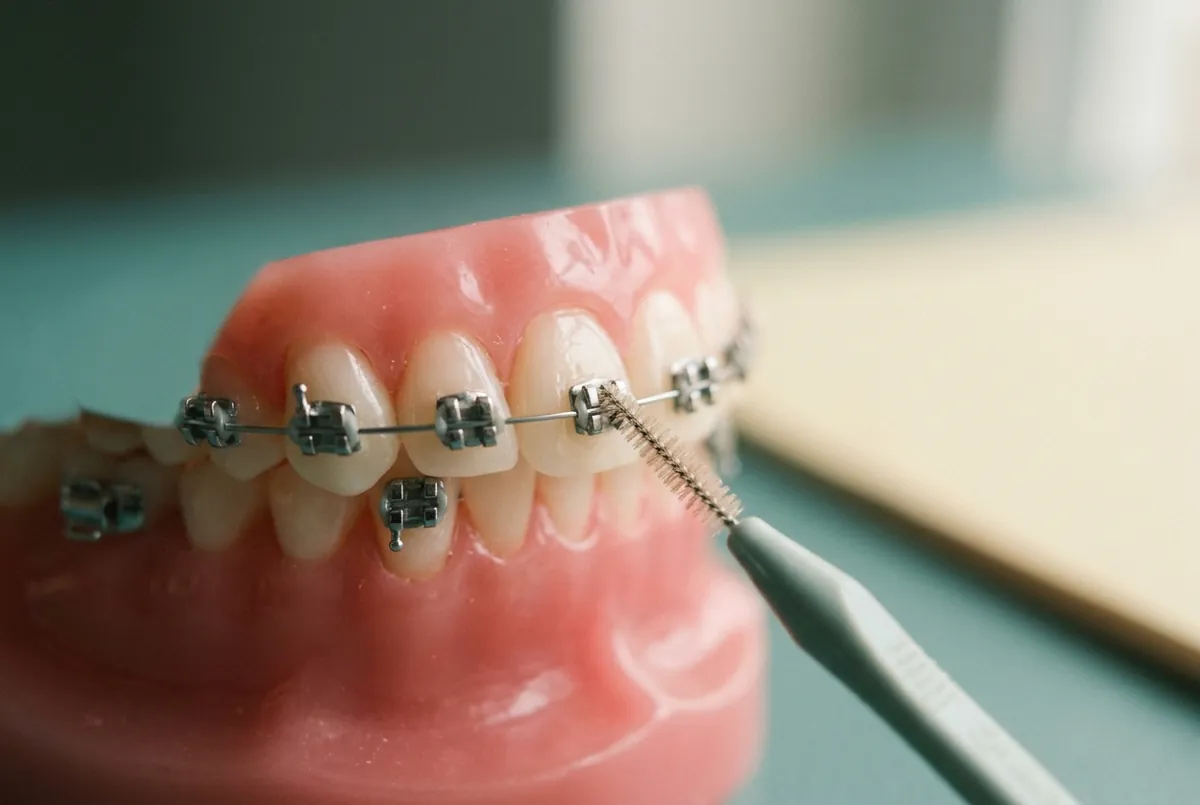
| Interdental or end-tuft brush | Daily | Reaches around brackets where the brush cannot |
| Fluoride mouthrinse, if advised | After brushing | Try not to rinse with water afterward |
| Sugary or acidic drinks | With meals, not sipped all day | Every sip restarts the acid |
| Photo of your front teeth | Every few weeks | Chalky patches show on camera before you can feel them |
The routine comes from the Canadian Association of Orthodontists, which asks for brushing after every meal and snack. Sipping a sugary drink across a whole afternoon keeps acid on the teeth for hours, so finishing it with a meal is kinder to enamel. A smile photo in good light every few weeks is a simple way to catch a spot early.
If a spot appears while you still have braces
Tell your orthodontist when you notice one. Longer treatment was linked with more white spots in the pooled review, which is one reason treatment time is worth discussing, and our article on whether you can speed up braces covers what the research says about that. A visit can also include a brushing review and a conversation about extra fluoride.
Your General Dentist or hygienist can help between orthodontic visits. If you qualify for the Canadian Dental Care Plan, its coverage page lists cleanings and fluoride applications among covered services, with frequency limits. Orthodontic treatment itself is not covered.
After the braces come off
Once the brackets are gone, plaque no longer has a place to hide and saliva and fluoride get a fair chance. Researchers in Amsterdam followed 58 patients with a light-based scanner and found 421 lesions at debonding, with some improvement at six weeks and again at six months, though the overall change was small. A Dutch group that photographed 51 patients at debonding and again a year later also saw lesions lessen. Expect a spot to soften slowly over months, if it softens at all.
If a mark bothers you, there is a short ladder of options. Fluoride toothpaste and a remineralizing paste come first. A dentist can also offer resin infiltration, where a thin resin is drawn into the porous enamel to change how it scatters light. The newest pooled review of that treatment, published in April 2026, covered 29 studies and 544 patients. It found inconsistent results from small studies with short follow-up and called for larger trials. Outcomes ranged widely from study to study, so ask your dentist what they have seen in their own patients before deciding.
A spot that turns brown, feels rough or becomes sensitive is a different matter. That can be a cavity, and it needs a dentist soon.
The short answer
Clean around the brackets after meals and snacks, keep fluoride toothpaste in the routine, ask about extra fluoride at your adjustment visits, and take a photo of your teeth now and then. Edmonton's fluoridated water is a good start for the enamel, and the daily cleaning covers the rest. If you spot something chalky, tell us early. Questions about your own teeth are easiest to answer in person, so book a complimentary consult and we will take a look.