


Adults with gum disease can often have braces, as long as the gum disease is treated first and stays under control. The 2022 European Federation of Periodontology guideline for advanced gum disease suggests orthodontic treatment for people whose periodontitis has been successfully treated, recommends starting once the goals of gum treatment are met, and asks for the gums to be checked, ideally at every orthodontic visit. Receding gums are a separate question with a more mixed answer, and a thin layer of gum over the front teeth is one of the clearest warning signs.
Adult braces are common. The Canadian Association of Orthodontists says more than one in four orthodontic patients in Canada are over 21, and it lists the health of the gums and supporting bone among the things that shape how treatment goes. In Edmonton the usual order is that your General Dentist or a periodontist, a specialist in gums, treats the gums first. The orthodontic work then starts with that team kept in the loop.
What gum disease does to tooth position
Periodontitis destroys the bone and fibres that hold teeth in place. As support is lost, teeth can drift, flare forward, lengthen and loosen. Patients usually notice it as front teeth spreading apart, new gaps, or a bite that no longer meets the way it used to. Dentists call this pathological tooth migration. It is the situation where braces can bring teeth back to a position the remaining bone can support.
The guideline was built from 13 systematic reviews, and it rated the evidence for orthodontic movement in these patients as moderate. Once the gum disease was treated, tooth movement did not significantly affect pocket depth or attachment, did not significantly increase root resorption, and seemed to reduce gum inflammation and tooth mobility. The orthodontic recommendations are numbered R7.1 to R7.8 in the guideline.
Braces with gum disease: the order of care
A sensible order, following the 2022 guideline
Before braces
Assess the gums
Your dentist or periodontist measures pocket depths around each tooth, notes where the gums bleed and checks bone levels on X-rays.
Before braces
Treat the gum disease
Cleaning under the gumline and, where needed, gum surgery.
Before braces
Confirm it has settled
The guideline starts orthodontic treatment once the goals of gum treatment are reached, which means no deep pockets that are still bleeding.
Planning
Plan the braces together
Reviews describe light, controlled forces. For severe gum disease the guideline suggests fixed appliances over removable ones, on low-quality evidence.
During braces
Recheck the gums at visits
Ideally at every orthodontic appointment. If gum disease flares, active tooth movement pauses while the gums are treated, then resumes.
After braces
Retain and maintain
A permanent fixed retainer, lifelong retention and lifelong supportive gum care.
Based on recommendations R7.2, R7.6, R7.7 and R7.8 of the European Federation of Periodontology guideline for stage IV periodontitis. Your own periodontist and orthodontist set the plan for your mouth.
Waiting is frustrating, but moving teeth while the gums are still inflamed is where the risk lies, which is why the guideline asks for stability first.
What the research can and cannot show
The evidence here is thinner than the guideline's tone suggests. A 2022 meta-analysis of 26 studies, all at high risk of bias, found that in stable treated periodontitis patients tooth movement had no significant effect on periodontal outcomes, though only 69 treated patients fed into that comparison. A 2023 review of five studies with 366 participants reached a similar conclusion and noted that every patient in those studies had received deep cleaning and gum surgery before the braces went on.
The question of moving teeth in inflamed gums rests on older animal work. In a 1988 experiment on monkeys with induced gum disease, pushing teeth into the bone while cleaning was kept up improved the gum's attachment to the tooth, and doing it without cleaning sometimes made bone loss worse. That is not proof for people, but it fits the guideline's advice to wait until inflammation is controlled, and it is why a cleaning routine is built into the plan.
Receding gums: who is at risk
Recession is a different problem from periodontitis, though the two can overlap. A 2023 review of 48 studies looked at who develops recession around orthodontic treatment. Ten of the 15 studies that compared how common recession was found more of it in orthodontic patients, and 10 of the 16 studies that looked at tipping the front teeth forward found more recession when that happened. A thin layer of gum, earlier recession, and the width and thickness of the firm gum were the factors correlated with risk in nine articles. Oral hygiene, treatment length and lip or tongue piercings were not linked to recession in the studies that tested them.
A 2018 review that looked only at adults whose lower front teeth were tipped forward found just two studies, and the effects they saw on recession were neither statistically nor clinically significant. The overall picture is mixed, with small studies that vary a lot in design. In practice, that makes a gum check before braces worth asking for, especially if the gum over your lower front teeth looks thin or has already pulled back. Tell your orthodontist if it has. A periodontist can say whether a graft or closer monitoring makes sense.
| Sign during treatment | What to do |
|---|---|
| Gums that bleed more than before, or look swollen and red | Tell your orthodontist and book a gum check with your dentist or periodontist |
| Gum pulling away from a tooth, so more root shows | Tell your orthodontist at the next visit, sooner if it is changing fast |
| A bad taste, pus or a pimple on the gum | Call your dentist or periodontist promptly, since this can be an abscess |
| A tooth that feels looser than it did | Call that week |
Paying for the gum treatment
Gum treatment is one place where public coverage can help. The Canadian Dental Care Plan's coverage page lists cleaning under the gumline and non-surgical gum disease management among covered services for eligible members, and some services need preauthorization. Orthodontic services are listed as currently not available. Members must have no access to private dental insurance and an adjusted family net income under $90,000, among other requirements, so check the federal page before assuming either way. For an adult hoping to start braces, the plan may help with the gum step even though it will not cover the braces. Our guide to paying for braces in Alberta covers the rest of the funding picture.
After the braces
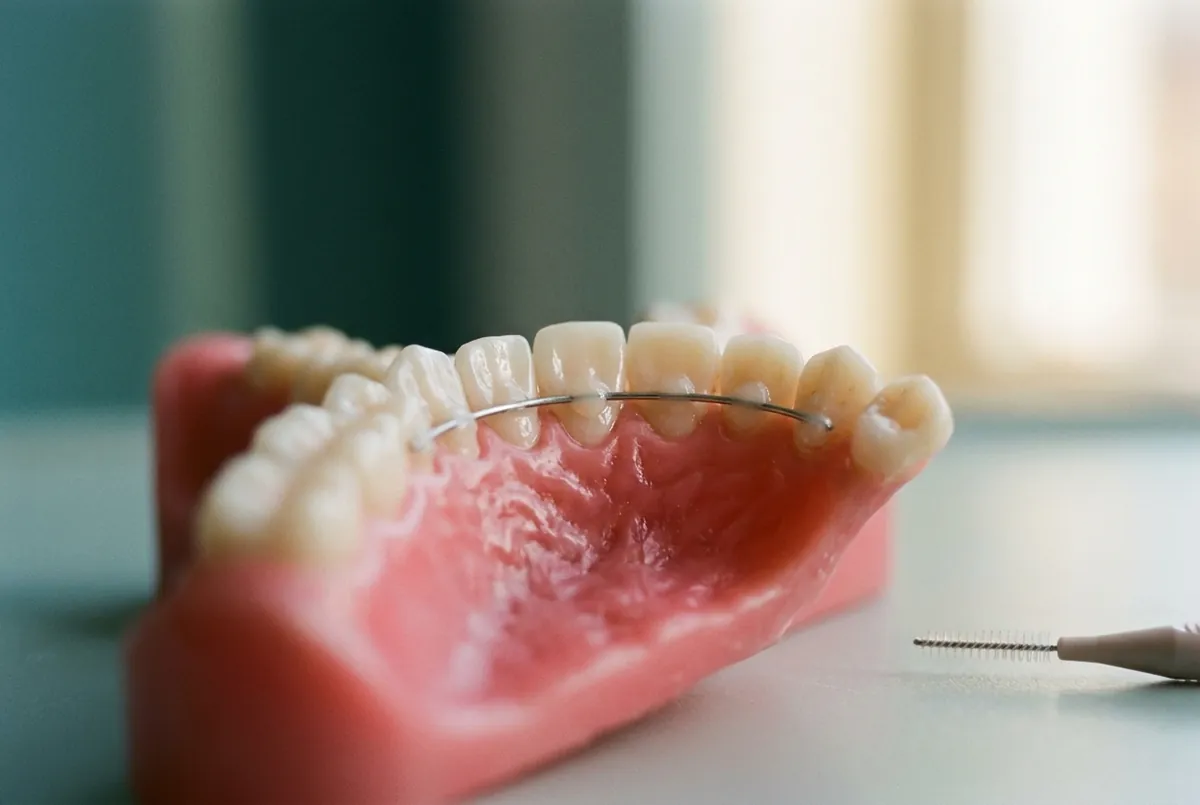
The guideline asks for a permanent fixed retainer, with or without a removable one, and lifelong follow-up to catch retainer failures or unwanted movement early. A wire bonded behind the teeth gives plaque a place to settle, so interdental brushes and floss threaders become part of the daily routine. Our article on how long to wear retainers covers what to expect, including what to do when a retainer breaks.
The short answer
Braces with gum disease are often possible, and the order matters: treat the gums, confirm they have settled, move the teeth gently, and keep checking. Receding gums deserve a closer look before treatment if the gum is thin or has already pulled back. The research is smaller than anyone would like, which is a reason to treat the plan as a team decision between your orthodontist and your dentist or periodontist. If you are not sure where you stand, our adult orthodontics page explains how we approach it, and a complimentary consult is a good place to start. Our guide on orthodontist vs dentist explains who does what.